
The Anti-Slavery Model Legislation was developed to assist States in giving effect to their international undertakings with regard to slavery and related exploitation crimes.
It provides information on States’ international legal obligations related to severe forms of human exploitation and offers a template for addressing these practices in States’ domestic legal orders. The Anti-Slavery Model Legislation therefore acts as a guide to facilitate the process of reviewing, amending, and adopting effective legislation.
Why is the Model Legislation needed?
The Anti-Slavery Model Legislation was developed to assist States in filling the critical gap in existing domestic legislation that was revealed by this Antislavery in Domestic Legislation Database, namely the domestic criminalisation of slavery and related exploitation crimes. This database revealed that although almost all States have adopted domestic legislation criminalising trafficking in persons, many States have yet to establish standalone prohibitions of slavery and related exploitation crimes. This is so despite the fact that most States have undertaken specific commitments to criminalise these forms of exploitation in their domestic legal systems through membership of a range of key international treaties.
What other practices are covered by the Model Legislation?
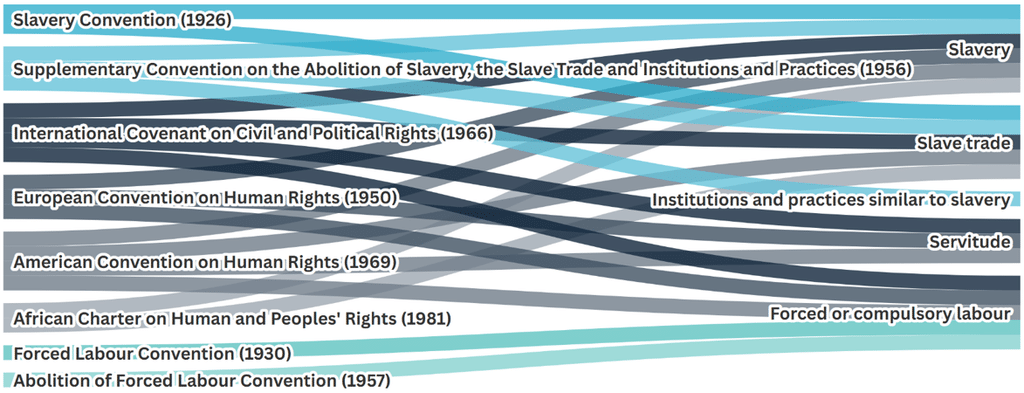
The Anti-Slavery Model Legislation covers severe forms of human exploitation prohibited in international law, which entail specific obligations of domestic criminalisation. Specifically: slavery; slave trade; servitude; forced or compulsory labour; and institutions and practices similar to slavery. The Anti-Slavery in Domestic Legislation Database also assessed domestic provisions related to trafficking in persons. However, this is the subject of an existing UNODC Model Law against Trafficking in Persons, and is therefore not covered in the Model Legislation.
The international legal foundations of the prohibitions
The Anti-Slavery Model Legislation provides guidance for the implementation of States’ international legal obligations to address exploitation crimes in their domestic law. These obligations are found in a range of international and regional treaties (see below). The Model Legislation is limited to the specific commitments to criminalisation contained in these international legal frameworks. As such, it reflects the core of States’ international obligations related to the domestic prohibition of exploitation crimes, rather than the full range of legislative measures that a state may adopt in order to give effect to their international commitments. In practice, States should consider a wide range of additional legislative measures to give full effect to their international obligations
What is included in the Model Legislation?
The Anti-Slavery Model Legislation includes three core components: four Guiding Principles; model legislative provisions covering eight exploitation types; and accompanying commentaries for each provision.
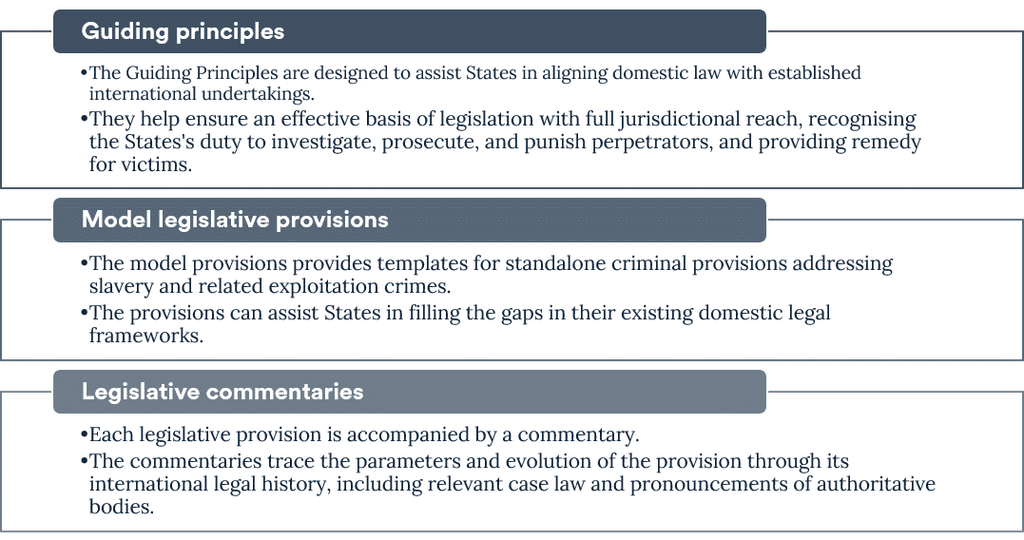
Together, these components help to equip States to assess both their international obligations and their existing domestic legislative frameworks, to ensure that international commitments are translated in their domestic legal order. The model provisions may be inserted into existing criminal law, or included in dedicated anti-slavery legislation.
Why is the Model Legislation being published now?
The Model Legislation was published on 25 September 2026—exactly 100 years from the adoption of the 1926 Slavery Convention in Geneva. Despite a century having passed since the international community marked this milestone achievement, slavery and related exploitation crimes continue to persist in every country and region of the world.
The centenary of the Slavery Convention marks an important inflection point for the international community. It represents a century of landmark progress in advancing human dignity, freedom, equality, and solidarity. At the same time, it draws attention to persistent challenges of slavery and related exploitation in the contemporary world, and the promises that have yet to be fulfilled. This moment, therefore, presents a critical opportunity for all States to renew their fundamental commitments to the complete eradication of slavery and related exploitation crimes, everywhere in the world they may take root.
Next steps
The Anti-Slavery in Domestic Legislation study highlighted a key gap in many States’ domestic legislative frameworks giving effect to their international obligations to criminalise slavery, slave trade, servitude, forced or compulsory labour, and institutions and practices similar to slavery. The Anti-Slavery Model Legislation provides practical guidance for States seeking to address these gaps. All States are encouraged to review their existing domestic legislation with an eye to identifying the gaps in the domestic prohibitions of slavery and related exploitation crimes distinct from domestic criminalisation of trafficking in persons. States are then invited to reform existing legislation or adopt new legislation to give full effect to their international commitments.